PSYCHOLOGY ARTICLE • EMPATH TRANSFORMATION
When the Empath Persona
Collapses
How to Stop Being the Savior and the Mirror
// SYSTEM NOTE: This piece explores patterns witnessed in empaths across many contexts. While rooted in lived experience and clinical observation, it is intended as a teaching about archetypal dynamics, not a personal testimony. The patterns described here are universal to the empath's journey toward sovereignty.
00_INIT: The Veil Thins
The veil thins as the year leans into its final darkness. And in that liminal space, those who are attuned to the world's psychic weather feel what others have not yet named. The trembling of an aeon ending. The first fractures in the collective's old architecture. It is not a sound you hear with your ears, but a vibration you feel in the marrow of your bones—a subterranean rumble that whispers of collapse and renewal in the same breath.
The architecture of the old world fading into the new.
I write about towers and mirrors and containers as if these were real structures. As if the architecture of the self were built from material things—brick, glass, steel. Perhaps they are. Perhaps they aren't. Perhaps calling them towers is just a way of making the invisible visible enough to work with. To give shape to the formless pressures that have defined your existence. Perhaps calling them mirrors is just a way of saying: "I am not myself. I am the reflection of what I think others see."
I'm sitting here trying to describe the indescribable experience of your nervous system recalibrating. I've used metaphors of towers and mirrors and containers. None of it is quite right. All of it is somehow true anyway. Because when you are in the thick of it—when the old identity is dissolving but the new one hasn't yet formed—you grasp for symbols. You reach for language that can hold the magnitude of the shift.
(This is what happens when you try to teach something that can only be lived. But here we are. Language is all I've got. So I'm doing my best to map a territory that shifts underfoot even as we walk it.)
The empath does not experience this as anxiety or restlessness. They perceive it as something older, deeper, almost prophetic: the great separation that has already begun its unfurling between what humanity has been and what it is being forced to become. It is a biological intuition, a somatic knowing that precedes logic. You feel the tectonic plates of the culture grinding together before the earthquake hits the news.
You are not imagining this. Your nervous system is not malfunctioning. You are reading signals that are actually there—signals that move through the collective psyche long before they arrive as events in the material world. You are the instrument that picks up the static before the broadcast begins. And for years, you have been told that this sensitivity is a defect. That you are "too sensitive," "too intense," "too much."
"The tower stands. The tower falls. The tower was never there. The tower is everywhere. The mirror reflects. The mirror lies. The mirror is the only truth. The mirror is the final deception. We built these structures to survive a world that felt dangerous, and now, the safety they provided has become the prison we must escape."
The exhaustion is not ordinary. It is not the tiredness of muscles or the weariness of routine. What the empath feels is the psychic death of the persona—the nice persona constructed to survive a world that never learned how to see them. This isn't burnout. It's metamorphosis. The empath is strangling in a skin that no longer fits. It is the exhaustion of holding up a sky that was never yours to carry. The fatigue of translating your vast, multidimensional self into a small, palatable language for those who only speak in monochrome.
But here's the thing: the mirror doesn't just shatter. It dissolves like sugar in rain. The tower doesn't just crack. It dances itself into a new shape. The container doesn't just empty. It overflows with what was never supposed to fit, and the overflow is kind of beautiful, actually. It is the messiness of rebirth. Chaos, yes, but a fertile chaos.
Your nervous system is finally firing on all cylinders—but for you, instead of for everyone else. Your dopamine system is waking up like it just discovered coffee. Your prefrontal cortex is showing up to the party for the first time in decades, ready to take command from the amygdala.
What psychologists call "anxiety" may be the empath's vagal system finally refusing to override its own danger signals to accommodate someone else's comfort. The empath's burnout is not a personal failure. It is a nervous system that has been in sympathetic overdrive for so long it has forgotten how to rest. It is a biological protest. A strike. A demand for a new contract with existence.
╔════════════════════════════════════════════════════════════════╗
║                                                                ║
║                    PART 1: THE VEIL THINS                      ║
║                                                                ║
╚════════════════════════════════════════════════════════════════╝
Part 1: The Veil Thins
The empath always perceives the future long before it arrives. This isn't mystical thinking—it's a function of a nervous system that has been calibrated to detect the subtlest shifts in emotional and energetic fields. The empath feels what others cannot yet name because their system has been trained, through necessity, to read the signals that most people ignore. You are the high-fidelity receiver in a world of low-fidelity noise.
This capability, however, comes with a heavy tax. Because society rarely validates the invisible, the empath learns to doubt their own data. "You're imagining things," they are told. "You're overreacting." And so, a split occurs. The empath continues to receive the signal, but they cease to trust the receiver. They begin to view their own clarity as a pathology.
// The Science of Sensitivity
The empath's nervous system operates differently. Research in polyvagal theory, developed by Stephen Porges, explains that highly sensitive individuals often have nervous systems that are more responsive to environmental cues. Your vagus nerve—the primary nerve of the parasympathetic nervous system—has been in a state of constant activation. It is scanning, always scanning. Is it safe? Is it congruent? Is the tone matching the words?
This is why the empath's exhaustion feels different from ordinary tiredness. The autonomic nervous system—the system that regulates heart rate, breathing, digestion, and stress response—has been dysregulated for years. The sympathetic branch (fight-or-flight) has been chronically activated to assess threat, while the parasympathetic branch (rest-and-digest) has been suppressed. You have been running a marathon while sitting still.
The Neural Architecture: TPJ vs Mirror System
True empathy relies on a delicate neurological balance. It engages the Temporoparietal Junction (TPJ)—the brain region involved in perspective-taking and distinguishing self from other. But for many empaths, the Mirror Neuron System dominates.
- TPJ (The Analyst): "I understand what you are feeling and why, and I recognize that this feeling belongs to you, not me." (Cognitive Empathy)
- Mirror Neurons (The Sponge): "I feel exactly what you are feeling right now, in my own body, as if it were happening to me." (Emotional Contagion)
When the mirror system fires without TPJ regulation, you don't just understand the pain—you become it. This is the physiological basis of the "Sensitivity" you've felt your whole life. It is not a character flaw. It is a routing error in the neural network.
// Diagnostic Instruments
To separate true perspective-taking from projection, we must audit the signal. Standard psychometric instruments like the Interpersonal Reactivity Index (IRI) and the CASES Model reveal the specific channels where corruption occurs. It allows us to debug the software of your empathy.
IRI: The Two Subscales
The cognitive ability to spontaneously adopt another's viewpoint. High scorers regulate their own emotions to model the other's mind. This is the goal state.
Self-oriented anxiety in response to other's suffering. High scorers flood with their own distress, leading to projection, withdrawal, and "empathic burnout."
CASES: Signal Channels
Accuracy of read. "I know that you are sad." (The Processor). This channel provides data without load.
Physical resonance. "I feel your sadness in my chest." (The Sensor). This channel provides connection but carries high metabolic cost.
The Critical Insight: High Somatic Mirroring + Low Cognitive Regulation = Projection. You feel intensely, but you misinterpret the source. You confuse your reaction to their pain with the pain itself.

System analysis: Vagal tone critical.
// The Canary in the Coal Mine
The veil thins, and the empath feels it first because they have always been the canary in the coal mine. Their sensitivity, which the world tried to make them believe was a weakness, is actually a form of early warning detection. It is evolutionary technology designed to keep the tribe safe.
In coal mines, canaries were used to detect toxic gases. If the canary stopped singing or died, it was a sign that the air was unsafe. The empath serves a similar function in the collective psyche. They feel what others cannot yet feel. They get sick when the environment is toxic, even if the toxins are invisible. They act out the shadow of the family system before anyone else admits the shadow exists.
// The Mechanics of Projection
But here is where the signal gets corrupted. Science distinguishes between two distinct modes of reading others: Imagine-Other (true empathy) and Imagine-Self (projection). This distinction is the difference between sanity and madness for the empath.
ERROR MODE: IMAGINE-SELF
"How would I feel if this happened to me?"
- Activates personal memory networks
- Triggers high personal distress
- Result: Projection. You overwrite their reality with your history. You solve for you, not them.
OPTIMAL MODE: IMAGINE-OTHER
"How does THEY feel right now?"
- Maintains self-other distinction
- Activates TPJ (Perspective Taking)
- Result: Accuracy. You read the signal without becoming the signal. You remain a separate, helpful entity.
Most "natural" empaths default to Imagine-Self. You see someone in pain, and you immediately access your own library of pain to understand them. This isn't empathy. It's an autobiographical overlay. You aren't feeling with them; you are remembering as you. This is why you get exhausted—you are reliving your own trauma every time you try to support someone else.
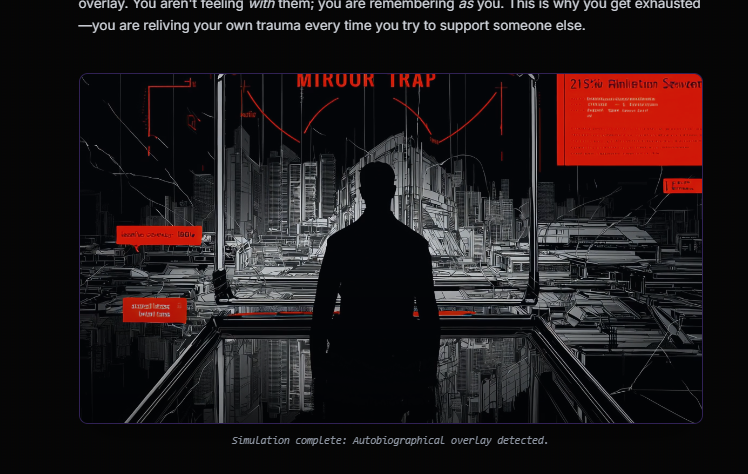
Simulation complete: Autobiographical overlay detected.
╔════════════════════════════════════════════════════════════════╗
║                                                                ║
║                  PART 2: THE NICE PERSONA                      ║
║                                                                ║
╚════════════════════════════════════════════════════════════════╝
Part 2: The Nice Persona
The nice persona was built on the illusion that if you were gentle enough, patient enough, forgiving enough, the world would not wound you. You believed peace would come from making yourself easy to love. But this ideal was a compensation for an ancient wound: the wound of being unseen. It was a strategic decision made by a very small child who realized that their authenticity was dangerous, but their compliance was rewarded.

The performance you forgot was a performance.
And so, you became the master of the "fawn response"—the fourth and least understood F in the trauma response quartet (Fight, Flight, Freeze, Fawn). Fawning is the immediate erasure of self to merge with the needs of a potential aggressor. It is saying "yes" when your body screams "no." It is smiling when you are terrified. It is apologizing for existing.
The child who is unseen becomes the adult who overfunctions. The child who is unprotected becomes the adult who shields others beyond their capacity. The child who is unloved for who they are becomes the adult who tries to earn belonging by offering endless emotional labor. You became a utility. A service provider of comfort. And because you were so useful, people kept you around. But being needed is not the same as being loved.
> For me, 'Nice' wasn't just polite; it was survival. It was a pre-emptive strike against abandonment. If I am the sweetest, most accommodating person in the room, you can't leave me. You can't hurt me. I fawned so hard I forgot what I actually liked. I'd agree with opinions I didn't hold. I'd laugh at jokes I didn't find funny. I was a hologram of a person. Letting go of the 'Nice Persona' feels like walking into a firing squad without a vest. It feels like I'm screaming 'reject me!' at the world. But the silence inside the hologram is getting louder than the applause outside.
But here's the truth: the persona never earned you love. It earned you approval. It earned you acceptance. It earned you safety. But approval and acceptance are not the same as love. Love sees you. Approval sees your performance. Love holds you. Approval consumes you.
The tragedy of the nice persona is that it isolates you even as it connects you. Because as long as you are performing, no one is actually connecting with you. They are connecting with the mask. And inside the mask, you are lonelier than ever, screaming in a soundproof room while everyone outside applauds the silence.
╔════════════════════════════════════════════════════════════════╗
║                                                                ║
║                  PART 3: THE TWO TRAPS                          ║
║                                                                ║
╚════════════════════════════════════════════════════════════════╝
Part 3: The Three Archetypes of Survival
Beneath the nice persona lie the deeper traps. The archetypal distortions that ensnare the empath are not random; they are specific structural failures. We call them the Savior, the Mirror, and the Container. These are not character flaws. They are survival strategies that became identities. They are the armor you put on so long ago you forgot your skin was underneath.
The structural integrity of the nice persona is failing.
> I don't just walk into a room; I dissolve into it. Being Fearful Avoidant means I crave connection like oxygen, but the moment I get it, I feel like I'm drowning. So I learned to become a Mirror. If I reflect exactly what you need to see, I'm safe. I'm close enough to feel your warmth, but hidden enough that you never actually touch me. I'd shapeshift seamlessly—becoming the cool girl, the therapist, the perfect listener—whatever the situation demanded. It felt like a superpower, this ability to merge. But it's a ghost's existence. I broke my own heart a thousand times trying to be the perfect reflection for people who never even asked to see me. I was terrified that if I stopped mirroring, I'd cease to exist. That underneath the reflection, there was no 'Maya', just a void waiting to be filled by someone else's needs.
// The Savior Archetype
The first trap is the Savior. This archetype forms not from arrogance but from fear. The fear that if the empath does not heal the other, they will collapse, and their collapse will engulf them. It is hyper-responsibility masquerading as love.
The Savior empath learned early that their presence was currency. Not their authenticity—their usefulness. They learned to read the room the way a soldier reads a battlefield. Always scanning. Always anticipating the next crisis. Always carrying the medkit for wounds they didn't inflict. They believe that they are the only thing standing between the people they love and total destruction. It is a god-complex born of powerlessness.
The weight of the collective weather.
// The Mirror Archetype
The second trap is even more insidious, for it masquerades as empathy itself: the Mirror. The Mirror does not just feel for others; they become them. They lose the distinction between where "you" end and "I" begin.
The Mirror does not allow individuation. It interrupts the formation of the self. It traps you in perpetual psychic adaptation. You become a chameleon, changing colors to match the rock you're sitting on, until one day you realize you don't know what color you actually are. You are everyone and no one.
Fragments of a self reflected in too many others.
Detection Patterns
THE MIRROR TRAP
Total Assimilation
Severity Score
9.5
"You are not a reflection."
Analysis: Subject exhibits 100% signal loss of original identity signature when in proximity to high-amplitude emotional sources.
Result: Complete psychological opacity failure. Subject becomes invisible to self.
// The Container Archetype
The third trap is the Container. This is the empath who holds space until they run out of air. They are the "rock," the "steady one," the designated listener. They allow others to dump toxic emotional waste into their psyche, believing that their strength lies in their capacity to endure.
But the Container is not filtering; they are accumulating. And unlike a real waste management system, they have no outlet. The toxicity builds up in the tissues, in the joints, in the silent resentment that grows like black mold in the basement of the soul.
// Field Simulations: The Projection Trap
How does this failure manifest in the field? It mascarades as deep connection. But analyze the data log, and the error becomes visible.
Scenario 01: The Misread Conflict
Input Signal
Partner is quiet at dinner. Short responses. Withdrawn.
Projection Response
"They are mad at me. I can feel the anger. I must have failed."
Reality Data
Partner is processing a work failure. Has nothing to do with you.
System Error
Your anxiety hijacked the read. You attributed your fear of abandonment to their silence.
Scenario 02: The Helping Trap
Input Signal
Friend is grieving a breakup.
Projection Response
"I know exactly how this feels. You must be devastated. You need to do what I did..."
Reality Data
Friend feels relief mixed with sadness. Your story is not their story.
System Error
Autobiographical overlay. You are counseling your past self, not the person in front of you.
Pattern recognition active. Identity cortex: 0%.
// Topological Failure: The Inclusion of Other in Self
Psychologists measure this using the Inclusion of Other in the Self (IOS) scale. Think of it as two circles: Self and Other.
- [ZONE 1]Healthy Empathy (Circles 3-4): The circles overlap slightly. Connection exists, but the perimeter is intact. You feel for them, but you know you are not them.
- [ZONE 2]Total Fusion (Circles 6-7): The circles merge. The membrane dissolves. You cannot tell whose nervous system is regulating whose. This is the "burned out empath" state—chronic activation because you are processing two lives with one nervous system.

Topology Warning: Perimeter breach detected.
Part 4: The Great Separation
The collapse, once it begins, cannot be reversed. And you have felt this truth pressing against the back of your mind like a dream you fear to remember. It is the moment gravity reverses, and everything that was held down by the weight of obligation begins to float up into the void. This separation is violent, yes, but it is also the first breath of air you have taken in decades.
The space between who you were and who you are becoming.
It is not merely your habits that are breaking. It is the psychic story you inherited before you even knew you were living inside one. The story that said your value was contingent on your suffering. The story that said love was something you had to earn through self-erasure. That story is burning down.
You may feel a terrifying numbness. This is normal. The numbness is not the absence of feeling; it is the insulation of the chrysalis. Your system has gone offline to upgrade its operating system. You cannot feel the old world because you are no longer compatible with it. You are unplugging from the matrix of codependency.
Friends may fade away. Dynamics that used to "work" (because you carried them) will suddenly collapse. Let them. The structures that can only stand if you hold them up are meant to fall. You are not the pillar of the world. You are just a person. And that realization—"I am just a person"—is the most radical freedom there is.
Part 5: Liminal Space
In this stage of your metamorphosis, the unconscious demands a reckoning with the emotional architecture of your childhood. You are in the hallway between doors. The old room is locked, and the new door hasn't opened yet. It is dark here. It is quiet. And in the silence, you finally hear the echo of your own needs.
The towers we built to survive.
Recalibration is the process of teaching your nervous system that it is safe to be separate. That "No" is a complete sentence. That you can disappoint people and still be worthy of love. That you can exist without being useful. This is the hardest work you will ever do. It requires overriding millions of years of evolutionary programming that equates "rejection" with "death."
SYSTEM RECALIBRATION
EXECUTING PATCH PROTOCOLS...
// Structural Integrity: The 3 Protocols
You cannot sustain high-voltage empathy without heavy-duty insulation. Boundaries are not walls; they are the containment field that allows the reactor to run without melting down.
Time Architecture
Prevent emotional overload by limiting duration. Your nervous system needs predictable on/off cycles. Unlimited availability is a guaranteed system vulnerability.
Access Control
Control when you are available for emotional labor. You are not an open server. You require authorization keys. Not every notification warrants an immediate nervous system response.
Responsibility Firewall
Distinguish between support and salvation. When you blur responsibility boundaries, your nervous system stays activated trying to "solve" something that isn't yours to solve.

New Architecture: Robust containers for high-voltage connection.
// System Recovery: Parasympathetic Activation
Burnout is not just mental; it is a nervous system stuck in "on" mode. To recalibrate, you must manually engage the parasympathetic branch.
The 3-Breath Reset
Inhale for 4. Hold for 4. Exhale for 6. The prolonged exhale signals safety to the amygdala.
Sensory Grounding
Name 5 things you see. Touch 4 things. Hear 3 things. Move processing from the limbic system to the cortex.
The Shake Off
Animals shake after stress to complete the cortisol cycle. You should too. Literally shake your body to discharge activation.
Part 6: Training the Neural Network
You cannot think your way out of a pattern you felt your way into. You must behave your way out. This is a somatic process, not an intellectual one. Your nervous system is a predictive engine. It predicts that if you set a boundary, you will die (or be abandoned, which to the mammalian brain is the same thing). You must prove it wrong. Not with affirmations, but with data.
This is where Neuroplasticity comes in. We are literally rewiring the brain's danger response. We do this through Titration: small, manageable exposures to the thing you fear. We don't flood the system; we inoculate it.
The Titration Protocol
The Micro-Boundary
Say "No" to something that doesn't matter. The toppings on a pizza. The movie choice. Watch your body react. Notice the spike in cortisol. Notice that you didn't die.
The Time-Delay
"Let me check my calendar." Buy yourself 24 hours of processing time before committing to anything. Train the nervous system to pause before merging.
The Disappointment Inoculation
Intentionally disappoint someone in a low-stakes way. Let a call go to voicemail. Cancel a coffee date with plenty of notice but without over-explaining. Sit with the discomfort of their disappointment without fixing it.
Each time you survive the discomfort of a boundary, you lay down a new neural track. You are building a "Safety Pattern" that competes with the old "Danger Pattern." Eventually, the Safety Pattern becomes the superhighway, and the Danger Pattern becomes an overgrown path you no longer take.
Synaptic restructuring in progress.
Part 7: Behavioral Overrides
When the pressure hits, your cortex goes offline. You revert to the Fawn response before you even know what happened. To counter this, we need pre-loaded scripts—algorithms that run automatically when the system detects a threat. We are installing a manual override switch for your empathy.
// The Sacred Pause
The most powerful tool in the empath's arsenal is The Pause. Fawning relies on speed. It relies on the immediate, knee-jerk "Yes." By inserting a 5-second pause, you interrupt the automatic firing of the survival circuit and bring the Prefrontal Cortex back online.
OLD SCRIPT (Auto-Pilot)
"Oh sure, I can do that! It's no problem at all."
(Internal State: Panic, Resentment, Self-Betrayal)
NEW SCRIPT (Manual Override)
"I need to check my capacity on that. I'll get back to you by tomorrow."
(Internal State: Autonomy, Calm, Integrity)
Command Line Interface for Boundaries
- Situation: Someone dumping emotion"I love you, and I also don't have the bandwidth to hold this right now. Can we talk about it on Tuesday?"
- Situation: Request for immediate help"I can't give you an answer right now. I need to sit with it."
- Situation: Invasive curiosity"That's a personal topic for me. I'm not ready to share that."
// Managing the Backlash
Be warned: When you stop playing your role, people will get upset. They will try to put you back in your box. They will call you "selfish," "cold," or "different." This is not a sign you are doing it wrong; it is a sign you are doing it right. You are disrupting the equilibrium of the system.
The Script for Backlash: "I know this is a change from how I usually show up. I'm learning to take better care of my energy so I can be present in a real way, not just a performative way. I appreciate your patience as I figure this out."
Establishing new routing protocols.
Part 8: Empathy in the Line of Fire
Peace is easy when you are alone. But the true test of this new architecture is not how it holds up in a monastery; it is how it holds up in a kitchen argument at 11 PM on a Tuesday. Conflict is the ultimate stress test for the empath. It is the wind tunnel where our new boundaries are tested against gale-force winds.
"The real mental discipline is staying curious about someone else's reality precisely when your brain is screaming that they are a threat to yours."
Research on couples shows that empathic accuracy—the ability to correctly interpret your partner's emotions—predicts better resolution. However, under high stress, specific physiological changes occur that effectively lobotomize your empathy. Your amygdala (threat detection) hijacks the bus, your prefrontal cortex (theory of mind) gets kicked off, and your mirror neurons paradoxically amplify emotional contagion while accuracy plummets. You feel *more*, but you understand *less*.
// The Empathic Conflict Checklist
This checklist is your emergency protocol. When conflict activates your threat response, you must manually engage the braking system. Each step is designed to pull your prefrontal cortex back online.
01. What Did They Actually Say? (The Fact Check)
State only observable facts. No interpretation. No tone reading. Just the transcript.
02. What Story Am I Telling Myself? (The Episodic Trace)
Notice your interpretation and trace it back to your past or fears. Where have you felt this before?
03. What Is Their Likely Reality? (Theory of Mind)
Separate your fear from their actual words. What is the most likely explanation that isn't about you?
04. Have I Checked If My Story Is True? (Metacognition)
Ask before assuming. Turn your assumption into a question.
WARNING: Red Flags You Are in Projection Mode
- Rapid Certainty: "I know EXACTLY why you did that." (Real empathy is tentative).
- Mind-Reading: Filling in blanks without asking data-gathering questions.
- Flooding: Intense reactions disproportionate to the moment (The "0 to 100" effect).
- Physiological Arousal: Heart racing, chest tight, fists clenched, shallow breathing.
- Defensive Posture: Arms crossed, turning away, urge to flee or freeze.
- All-or-Nothing Thinking: "You always" / "You never." (Cognitive distortion).
Part 9: The Architecture of Leadership
For those who lead—managers, coaches, parents—the trap is even deeper. Leadership attracts the "Over-Functioning Savior" because organizations love a person who will carry the water for everyone else. You are the trusted one. The "one who gets it." And by Friday, you are depleted, numb, and wondering if you can keep doing this without losing your soul.
// The Leader's Empathy Trap
Neurologically, when you "over-function," your Goal Hierarchy Collapse occurs: your organizational goals merge with individual rescue missions. Your Working Memory gets overwhelmed holding too many subjective contexts. Your Dopamine System learns a broken prediction: "No matter what I do, there is continually more need."
The 4 Types of Boundaries Leaders Need
01. Scope of Expertise
Defining what you can help with vs. what requires verification.
02. Emotional Availability
Defining when you are accessible. Parasympathetic recovery is non-negotiable for sustained leadership.
03. Role Clarity
Supporter, not rescuer. Supporter, not fixer. Empowering others means letting them carry their own weight.
04. Confidentiality
Being transparent about limits builds safety.
The "Coach Approach"
Instead of answering every question, turn it back. This activates their prefrontal cortex and spares yours. It shifts the cognitive load back to where it belongs.
- "Help me understand how this looks from your side."
- "If you were in my shoes, what would you need from me?"
- "What would success look like for you specifically?"
- "What have you already tried?"
Part 10: The Sovereign Self
Sovereignty is not isolation. It is not building a wall so high that no one can climb it. It is simply the recognition that you are a territory unto yourself. That you have borders. That you have a government. And that you—and only you—are the ruler of this domain.
For years, you ran your territory like an open-air market, allowing anyone to set up a stall, pitch a tent, or dump their trash in the town square. You called it "being nice." You called it "being helpful." But really, it was an abdication of throne.
The architecture of a self that stands alone, together.
"Here's what no one tells you about sovereignty: it feels fucking good. Not holy. Not transcendent. Just... good. It feels like waking up in a room that is finally the right temperature. It feels like sitting in a chair that actually fits your body. It is the quiet, unspectacular relief of finally occupying the space you were designed to hold."
You are ready now. The tower is built. The mirror is clear. The container is sealed. You are no longer the sponge for the world's pain. You are the witness to its beauty, and the guardian of your own light.
Use This Architecture?
This is just the psychology layer. The full technical framework for building sovereign digital systems returns soon.
